Du har loggat ut.

Hej !
Logga ut
Kontakt

Hudvård

Hudskador och ärrbildning

Läkare spelar ofta en nyckelroll förebyggande och i tidig upptäckt av hudsjukdomar. Första linjens förebyggande åtgärder rekommenderas innan dessa komplicerade problem uppstår.1 Men även i senare stadier av sårläkningsprocessen kan förebyggande åtgärder som strukturerad ärrbehandling i de flesta fall effektivt begränsa onödig ärrbildning. Om omfattande bildning av ärrvävnad kan förhindras kan det vara nog så viktigt för patientens välbefinnande.2

Välkommen till vår information för hälso- och sjukvårdspersonal

Här hittar du information om produkter och tjänster för dig som arbetar inom vården.


Arbetar du inom ett vårdyrke?

Bekräfta Ja, jag arbetar inom hälso- och sjukvården. Avbryt Nej, jag arbetar inte inom hälso- och sjukvården.

grön och lila vattendroppsillustration

grön illustration av inkontinens

lila cirkeldiagram

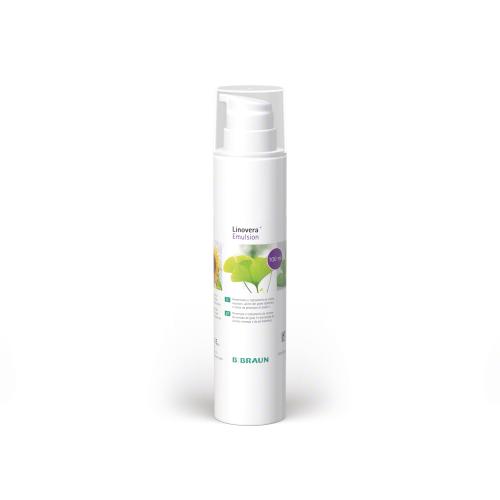
Linovera® Emulsion

Chronic wounds are a major global medical concern,1 significantly impacting patients’ quality of life,2 while also affecting close family and relatives. Chronic wounds also cause considerable financial burden3 on the healthcare system and society.Topical preventive measures such as Linovera® Emulsion are needed to avoid higher healthcare expenditures and preserve patients’ health. They can be used with the goal of promoting integrity of the skin and providing essential moisturizing.4HOFA-containing topical formulations have become an ideal therapeutic option that is part of the clinical protocols for nursing action in the prevention and treatment of ulcers.5Linovera® Emulsion is a light emulsion moisturizing cream composed of:Hyperoxygenated fatty acids (HOFA) originated from sunflower oil naturally rich in linoleic acid,6 an essential fatty acid important in the maintenance of epidermal integrity and the natural skin’s water barrier.7 Some of the HOFA properties can increase skin resistance, reduce dehydration, reduce friction and pressure forces8 and improve microcirculation.9  Vegetable extracts formulated to provide additional benefits such as skin conditioning, humectant and tonic, enhancing the activity of the product.How Linovera® Emulsion can be usedThanks to its content of HOFA and vegetable extracts, Linovera® Emulsion can be useful in the prevention of skin breakdown (e.g. pressure ulcers, vascular ulcers, and diabetic foot ulcers) or in the management of already impaired skin8,10 helping to provide the best care for your patients.With its creamy consistency, Linovera® Emulsion is easy to apply on large body areas, such as limbs and feet11.CompositionHyperoxygenated fatty acids derived from sunflower oil (emollient)Aloe Barbadensis extract (skin conditioning, emollient, humectant)Asian Centella oil extract (skin conditioning, skin tonic, soothing agent)Rosemary essential oil (organoleptic)Ginkgo biloba (skin conditioning)IndicationsLinovera® Emulsion is indicated: For patients whose skin integrity is at riskFor prevention of pressure ulcers, vascular ulcers and diabetic foot ulcersFor treatment of stage 1  pressure ulcersFor large skin surfaces, such as whole lower limbs

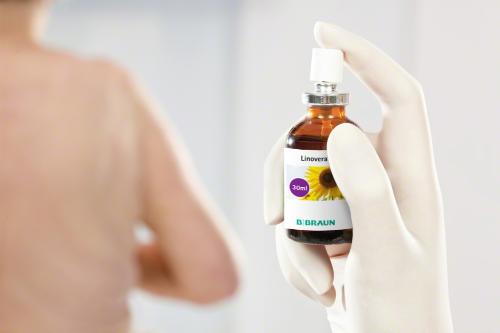
Linovera®

Chronic wounds are a major global medical concern,1 significantly impacting patients’ quality of life,2 while also affecting close family and relatives. Chronic wounds also cause considerable financial burden3 on the healthcare system and society.Topical preventive measures such as Linovera® oil are needed to avoid higher healthcare expenditures and preserve patients’ health. They can be used with the goal of promoting integrity of the skin and providing essential moisturizing.4HOFA-containing topical formulations have become an ideal therapeutic option that is part of the clinical protocols for nursing action in the prevention and treatment of ulcers.5 Linovera® is a skin care oil composed of: Hyperoxygenated fatty acids (HOFA) originated from sunflower oil naturally rich in linoleic acid,6 an essential fatty acid important in the maintenance of epidermal integrity and the natural skin’s water barrier.7 Some of the HOFA properties can increase skin resistance, reduce dehydration, reduce friction and pressure forces8 and improve microcirculation.9Vegetable extracts formulated to provide additional benefits such as skin conditioning, humectant, and tonic, enhancing the activity of the product. Thanks to its content of HOFA and vegetable extracts, Linovera® oil can be useful in the prevention of skin breakdown (e.g. prevention of stage 1 pressure ulcers) or in the management of already impaired skin,8,10 helping to provide the best care for your patients. CompositionHyperoxygenated fatty acids derived from sunflower oil (emollient)Aloe Barbadensis extract (skin conditioning, emollient, humectant)Asian Centella oil extract (skin conditioning, skin tonic, soothing agent)Rosemary essential oil (organoleptic) IndicationsLinovera® oil is indicated: For patients whose skin integrity is at riskFor prevention of pressure ulcers, vascular ulcers and diabetic foot ulcersFor treatment of stage 1 pressure ulcers

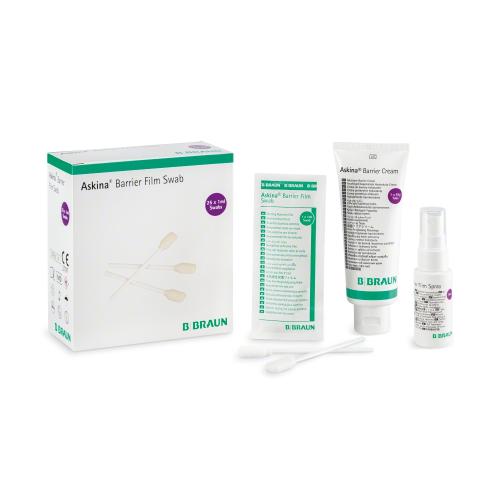
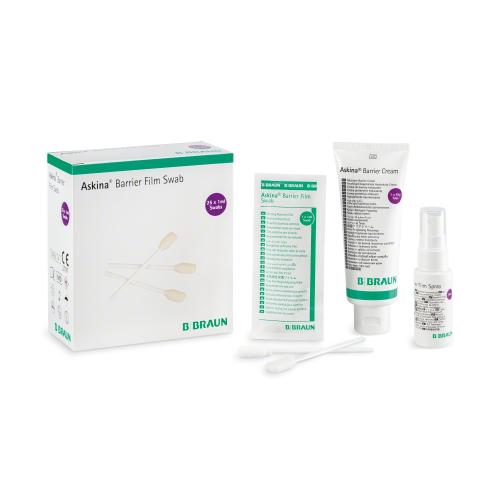
Askina® Barrier Cream

Askina® Barrier Cream is a white concentrated cream that provides protection to skin from body fluids. It protects dry, chafed, red, or irritated skin by moisturizing the skin and providing a long-lasting barrier.(1)

Askina® Barrier Film Swabs

Askina® Barrier Film Swabs are sterile foam applicators with a polymeric solution which offer between 48-72h of protection to intact or damaged skin. The non-stinging solvent forms a uniform film when applied to the skin. It is a multiple use device that is intended for single patient use.(1) 

grön illustration med personer med ärr

Ärrillustration

Referenser

  1. Banharak S, Panpanit L, Subindee S, Narongsanoi P, Sanun-Aur P, Kulwong W, Songtin P, Khemphimai W. Prevention and Care for Incontinence-Associated Dermatitis Among Older Adults: A Systematic Review. J Multidiscip Healthc. 2021 Oct 26;14:2983-3004. doi: 10.2147/JMDH.S329672. PMID: 34729012; PMCID: PMC8556723.
  2. Roseborough IE, Grevious MA, Lee RC. Prevention and treatment of excessive dermal scarring. J Natl Med Assoc. 2004 Jan;96(1):108-16. PMID: 14746360; PMCID: PMC2594768.
  3. Beeckman D, Van Damme N, Schoonhoven L, Van Lancker A, Kottner J, Beele H, Gray M, Woodward S, Fader M, Van den Bussche K, Van Hecke A, De Meyer D, Verhaeghe S. Interventions for preventing and treating incontinence-associated dermatitis in adults. Cochrane Database Syst Rev. 2016 Nov 10;11(11):CD011627. doi:10.1002/14651858.CD011627.pub2. PMID: 27841440; PMCID: PMC6464993.
  4. Gray M, Beeckman D, Bliss DZ, Fader M, Logan S, Junkin J, Selekof J, Doughty D, Kurz P. Incontinence-associated dermatitis: a comprehensive review and update. J Wound Ostomy Continence Nurs. 2012 Jan-Feb;39(1):61-74. doi: 10.1097/WON.0b013e31823fe246. PMID: 22193141.
  5. Sund B. New Developments in Wound Care. First Edition. London: PJB Publications; 2000. pp. 1–255
  6. Gauglitz GG, Korting HC, Pavicic T, Ruzicka T, Jeschke MG. Hypertrophic scarring and keloids: pathomechanisms and current and emerging treatment strategies. Mol Med. 2011 Jan-Feb;17(1-2):113-25. doi: 10.2119/molmed.2009.00153. Epub 2010 Oct 5. PMID: 20927486; PMCID: PMC3022978.